The JTMA3207 combines a constant-current/constant-volt-age linear single cell Li+ battery charger with a low drop-out linear regulator. Both charger and linear regulators can work independently. The

发布时间:2020-04-06 09:43:38 浏览次数:702 作者:嘉泰姆 来源:1
摘要:The JTMA3207 combines a constant-current/constant-volt-age linear single cell Li+ battery charger with a low drop-out linear regulator. Both charger and linear regulators can work independently. The
目录

,产品概述(General Description)         
       The JTMA3207 combines a constant-current/constant-volt-age linear single cell Li+ battery charger with a low drop-out linear regulator. Both charger and linear regulators can work independently. The small DFN-10 package and low external component count make the JTMA3207 ideally
suit to portable applications.
      The charger of JTMA3207 provides 0.7A charge currentwith thermal regulation protection to optimize the board design for compact size and typical thermal conditions.When the junction temperature reaches the thermal regu-lation threshold, the charger does not shut down but sim-
ply reduces the charge current. The charge current can be programmed by connecting an external resistor from the ISET pin to the GND. Using an external MOSFET to disconnect the resistor from the ground shuts down the charger, and reduces the input current down to 25μA.
The JTMA3207 also has the STAT pin to indicate charge status.
The LDO regulator of JTMA3207 can deliver up to 150mA current and dropout voltage is only 200mV. The 4μA low quiescent current makes it ideally suit to battery-power 
systems. The LDO regulator also has built-in current limit and thermal shutdown protection.
 
二</span>.产品特点(Features)
1.)Programmable Charge Current Up to 700mA
2.)</strong>Charge Status Output Pin
3.)</strong>Soft-Start Limits Inrush Current
4.)</strong>4.2V Charge Termination Voltage with ±1%Accuracy
5.)</strong>45mA Pre-charge Current (RSET=2k)
6.)</strong>Thermal Regulation of Charge Current Simplifies Board Design
7.)</strong>Charger Enable/Disable Control
8.)</strong>Ultra Low Regulator Quiescent Current: 4μA
9.)</strong>Fixed LDO Regulator Output Voltage: 3.3V
10.)</strong>Low Regulator Dropout Voltage: 200mV@150mA
11.)</strong>LDO Regulator Current Limit Protection
12.)</strong>LDO Regulator Short Circuit Current Limit
13.)</strong>LDO Regulator Thermal Protection
14.)</strong>Small 3mmx3mm DFN 10-Pin (DFN-10) Package
15.)</strong>Lead Free and Green Devices Available (RoHS Compliant)


三</span>,应用范围 (Applications)
PDAs
MP3 Players
Cell Phones

Wireless Appliances

四.下载产品资料PDF文档 
JTMA3207
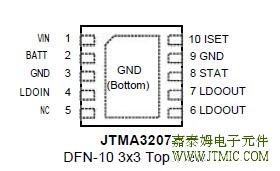
  • 五,产品封装图 (Package)

    FUNCTION

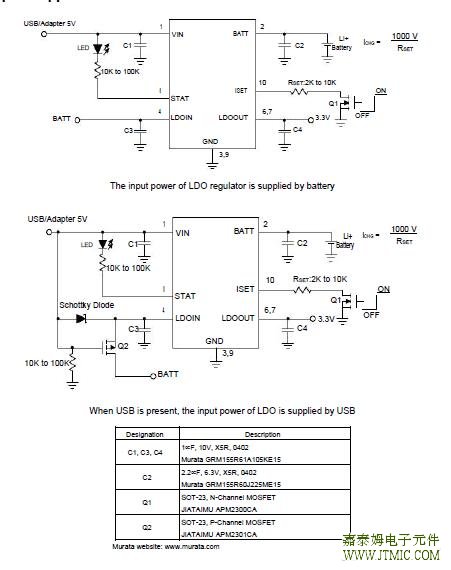
    六.电路原理图</span>


    vW7嘉泰姆

  • PINFUNCTION
    NO.NAME
    1

    VINCharger Input Supply Pin. Provides power to the charger, VIN can range from 4.35V to 6.5V and should
    be bypassed with at least a 1μF capacitor.

    2BATTCharger Output Pin. Connect this pin to the positive terminal of a Li+ battery.
    4LDOINLDO Regulator Input Supply Pin. Provides power to the regulator, VLDOIN can range from 3.6V to 6.5V
    and should be bypassed with at least a 1μF capacitor.
    5NCNo Connection.
    6,7LDOOUTLDO Regulator Output. Fixed at 3.3V output, sourcing up to 150mA. The pin6 and pin7 must be
    connected together.
    8STATOpen-Drain Charge Status Output Pin. When the battery is charging, the STAT pin is pulled low by an
    internal switch. In other states the STAT pin is in a high impedance state.
    3,9GNDGround. Pin3 and pin9 must be connected together.
    10ISETCharging Current Setting and Shutdown Pin. Connecting a resistor from this pin to GND set the charge
    current when the VIN is powering the charger. Disconnecting the RSET from GND allows an internal
    2.5μA current to pull the ISET pin high, and when the ISET pin voltage exceeds the shutdown
    threshold voltage, the charger enters shutdown mode.
    Bottom
    Pad
    GNDGround. Connect the bottom side metal pad to back side ground plane through several vias to improve
    power dissipation.
  • 七</span>,功能概述
    Input Capacitors
    The JTMA3207 requires proper input capacitors to supply surge current during stepping load transients to prevent
    the input rail from dropping. The 1μF ceramic capacitors are recommended to place on the input supply pins (VIN
    and VLDOIN) to the GND. Place the capacitors as close as possible to the input supply pins for well operation. In
    some start-up conditions, it may necessary to protect the device against a hot plug input voltage. Adding a 6V input
    zener diode between the input supply pins and the GND clamps the input voltage peak.
     
    Output Capacitors
    The JTMA3207 has two output pins, which are charger output pin BATT and regulator 3.3V output pin LDOOUT.
    The output capacitor of charger is recommended to use 2.2μF ceramic capacitor to ensure the battery charge
    stability.
    The output capacitor of regulator also can use ceramic capacitor, and its proper value is between 1μF and 2.2μF,
    ESR must above 10mΩ. Large output capacitor values can reduce noise and improve load-transient response,
    stability, and PSRR. With X5R and X7R dielectrics, 1μF is sufficient at all operating temperatures.
     
    STAT Pin
    The STAT pin can be used to drive a LED or communicate with the host processor to show the charge status. When
    the status is displayed by a LED, which has a current rating less than 5mA, a resistor should be selected to
    connect LED in series, for programming at the desired current value. The resistor is calculated by the following
    equation:

     Thermal Consideration
     
    The most common measurement of package thermal performance is thermal resistance measured from the
    device junction to the air surrounding the package sur-face (èJA). The èJA can be calculated by the following
    equation: 
    where:
    TJ= device junction temperature, maximum TJ=120°C TA= ambient temperature PD= device power dissipation
    The device power dissipation, PD, is a function of the charge rate, the LDO output current and the voltages drop
    across the internal FETs.It can be calculated by the following equation:
     
    PD = (VIN − VBATT ) × ICHG + (VLODIN − VLDOUT ) × ILDO
    PCB Layout Consideration
    Connecting the battery to BATT as close as possible pro-vides accurate battery voltage sensing. The input and
    output decoupling capacitors and the programmed re-sistor RSET should be placed as close as possible to the
    device. The high current paths (VIN and LDOIN pins for input and BATT and LDOOUT pins for output) must be
    short and wide to minimize voltage drop.

    八,相关产品

    vW7嘉泰姆

  • When STAT pin is monitored by a processor, there should be a 10kΩ to 100kΩ pull-up resistor to connect the STAT
    pin and the supply voltage of the processor.
  • Part_No  Package & Pins  Input Voltage (V)  Quiescent Current (typ)(uA)  Charge Current (max)(A)  Battery Charge Voltage  VIN OVP  USB Input  Battery-Load Switch  Charge State Output 
    minmax
    JTMA3200
    4.356200010004.2YYYY
    JTMA3201DFN3x3-104.356200010004.2NNNY
    JTMA3202SOT-23-54.3563005004.2NNNY
    JTMA3207DFN3x3-104.356.53005004.2NNN


vW7嘉泰姆

文章标签

暂无标签

发表评论

共有条评论
用户名: 密码:
验证码: 匿名发表