
 中文
中文 English
The JTM3232 is a 3V powered EIA/TIA-232 and V.28/V.24 communication interface with low power requirements, high data-rate capabilities. JTM3232 has a proprietary low dropout transmitter output
一,产品概述(General Description)
providing true RS-232 performance from 3 to 5.5V supplies. The device requires only four small 0.1 μF standard external capacitors for operations from 3V supply.
The JTM3232 has two receivers and two drivers. The device is guaranteed to run at data rates of 120Kbps while maintaining RS-232 output levels. Typical applications are Notebook, Subnotebook and Palmtop Computers, Battery Powered Equipment, Hand-Held Equipment, Peripherals and Printers.
二</span>.产品特点(Features)
300 μA SUPPLY CURRENT
· 120Kbps MAX GUARENTEED DATA RATE
· 3V/μs MINIMUM GUARANTEED SLEW RATE
· ENHANCED ESD SPECIFICATIONS:
±15kV IEC61000-4-2 Air Discharge
±8kV IEC61000-4-2 Contact Discharge
· AVAILABLE IN
DIP-16, SO-16,TSSOP16 AND
SOP16L(W)
三</span>,应用范围 (Applications)
四</span>,产品封装图 (Package)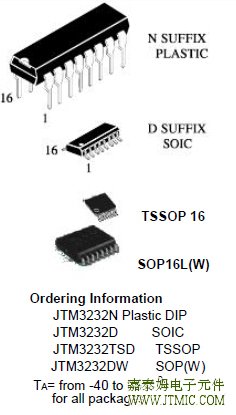
| PlN N° | SYMBOL | NAME AND FUNCTION |
| 1 | C1+ | Positive Terminal for the first Charge Pump Capacitor |
| 2 | V+ | Doubled Voltage Terminal |
| 3 | C1 | Negative Terminal for the first Charge Pump Capacitor |
| 4 | C2+ | Positive Terminal for the second Charge Pump Capacitor |
| 5 | C2 | Negative Terminal for the second Charge Pump Capacitor |
| 6 | V- | Inverted Voltage Terminal |
| 7 | T2OUT | Second Transmitter Output Voltage |
| 8 | R2IN | Second Receiver Input Voltage |
| 9 | R2OUT | Second Receiver Output Voltage |
| 10 | T2IN | Second Transmitter Input Voltage |
| 11 | T1IN | First Transmitter Input Voltage |
| 12 | R1OUT | First Receiver Output Voltage |
| 13 | R1IN | First Receiver Input Voltage |
| 14 | T1OUT | First Transmitter Output Voltage |
| 15 | GND | Ground |
| 16 | VCC | Supply Voltage |
五</span>,电路原理图</span>
六</span>.产品PDF文档
 | JTM3232 |
七</span>,功能概述
ESD structure is for rugged applications and environments sensitive to electro -static discharges and
associated transients. The ESD tolerance is at least ±15kV without damage or latch-up.
There are different methods of ESD testing applied:
a) MIL-STD-883, Method 3015.7
b) IEC1000-4-2 Air-Discharge
The Human Body Model has been the generally accepted ESD testing method for semiconductors.
This method is also specified in MIL-STD- 883, Method 3015.7 for ESD testing. The premise of this ESD testi
s to simulate the human body’s potential to store electro-static energy and discharge it to an integrated
circuit. The simulation is performed by using a test model as shown in Figure 1. This method will test the IC’s
capability to withstand an ESD transient during normal handling such as in manufacturing areas where the
ICs tend to be handled frequently.
The IEC-1000-4-2, formerly IEC801-2, is generally used for testing ESD on equipment and systems.
For system manufacturers, they must guarantee a certain amount of ESD protection since the system itself is
exposed to the outside environment and human presence. The premise with IEC1000-4-2 is that the system
is required to withstand an amount of static electricity when ESD is applied to points and surfaces of the
equipment that are accessible to personnel during normal usage. The transceiver IC receives most of the
ESD current when the ESD source is applied to the connector pins. The test circuit for IEC1000-4-2 is shown
on Figure 2. There are two methods within IEC1000-4-2, the Air Discharge method and the Contact
Discharge method.
With the Air Discharge Method, an ESD voltage is applied to the equipment under test (EUT) through
air. This simulates an electrically charged person ready to connect a cable onto the rear of the system only to
find an unpleasant zap just before the person touches the back panel. The high energy potential on the
person discharges through an arcing path to the rear panel of the system before he or she even touches the
system. This energy, whether discharged directly or through air, is predominantly a function of the discharge
current rather than the discharge voltage. Variables with an air discharge such as approach speed of the
object carrying the ESD potential to the system and humidity will tend to change the discharge current. For
example, the rise time of the discharge current varies with the approach speed.
八,相关产品
| RS232接口IC | |||||||||
| 型号 | 工作电压 | 静电保护 | 接口方式 | 工作方式 | 输出方式 | 传输速率 | 封装 | 替代型号 | |
| JTM232 | 4.5V--5.5V | 15KV | RS232 | 全双工</td> | 三态输出</td> | 140Kbps | SOP-16 | MAX232/SP232 | |
| JTM3232 | 3.0V--5.5V | 15KV | RS232 | 全双工</td> | 三态输出</td> | 140Kbps | SOP-16 | MAX3232/SP3232 | |
| 我司的JTM485/JTM3085/JTM13085有以下<a href="http://www.jtm-ic.com/a/xinwenzhongxin/xinpinjishu/" target="_blank" style="padding: 0px; margin: 0px; color: rgb(37, 110, 177); text-decoration: none;">优点:</td> | |||||||||
| 1. 通讯端口静电保护(人体模式):±15kV。</td> | |||||||||
| 2. 其余管脚ESD电压>3000V。</td> | |||||||||
| 3. 总线允许多达256只<a href="http://www.jtm-ic.com/a/xinwenzhongxin/" target="_blank" style="padding: 0px; margin: 0px; color: rgb(37, 110, 177); text-decoration: none;">收发器</span>。</td> | |||||||||
| 4. 三态输出,最大2Mbps工作速率以及半双工工作模式。</td> | |||||||||
| 5. 工业级防电磁干扰(EMI)的收发接口。 | |||||||||
| 6. 工业级的工作温度范围:-40°C - +85°C。</td> | |||||||||
| 我司的JTM232有以下优点: | |||||||||
| 1. 通讯端口静电保护(人体模式):±15kV。</td> | |||||||||
| 2. 其余管脚ESD电压>3000V。</td> | |||||||||
| 3. 三态输出,最大140Kbps工作速率以及全双工工作模式。</td> | |||||||||
| 4. 工业级防电磁干扰(EMI)的收发接口。</td> | |||||||||
| 5. 工业级的工作温度范围:-40°C - +85°C。</td> | |||||||||


发表评论